Noun (Basic ㊦ 447)
A noun that indicates a benefit, a purpose, a reason or a cause.
Equivalent: On account of ~; for the benefit of ~; for the good of ~; for the sake of ~; on behalf of ~; for the purpose of ~; in order to ~; because of ~; owing to ~
| (i) {V/Adjective い} informal | ために | |
| {話す /話した} ために | In order to talk/because someone talks/talked | |
| {食べる /食べた} ために | In order to eat/because someone eats/ate | |
| {高い /高かった} ために | Because something is/was high | |
| (ii) Adjective な stem | {な/だった} ために | |
| {静かな/静かだった} ために | Because something is/was quiet | |
| (iii) Noun | {の/だった} ために | |
| {先生の/先生だった} ために | For the sake of the teacher/because of the teacher/because someone is/was a teacher | |
| (iv) Demonstrative Adjective | ために | |
| {この /その} ために | For the sake of this/that, because of this/that |
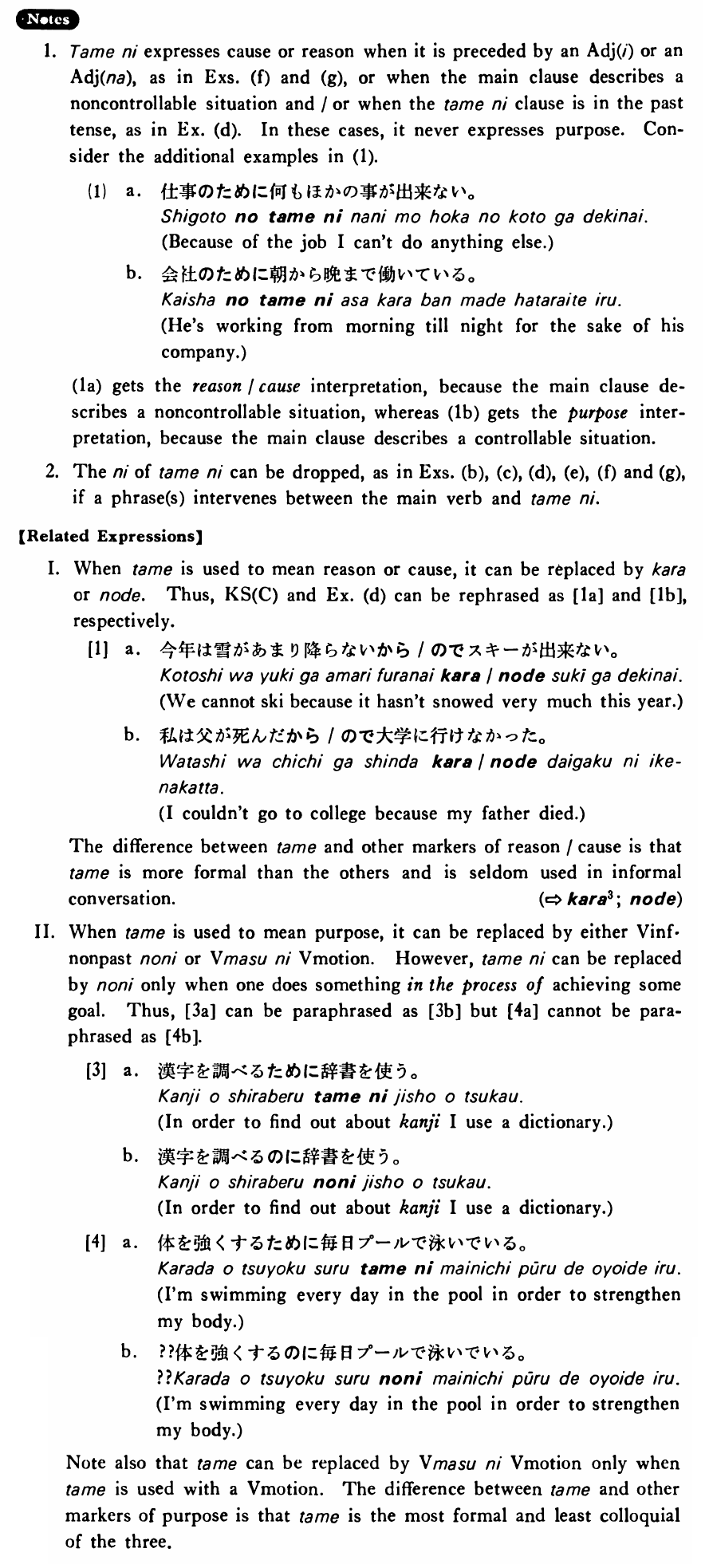
1. 為に expresses cause or reason when it is preceded by an Adjective い or an Adjective な, as in Examples (f) and (g), or when the main clause describes a noncontrollable situation and/or when the 為に clause is in the past tense, as in Example (d). In these cases, it never expresses purpose. Consider the additional examples in (1).
(1a) gets the reason/cause interpretation, because the main clause describes a noncontrollable situation, whereas (1b) gets the purpose interpretation, because the main clause describes a controllable situation.
2. The に of 為に can be dropped, as in Examples (b), (c), (d), (e), (f) and (g), if a phrase(s) intervenes between the main verb and 為に.
【Related Expressions】
I. When 為 is used to mean reason or cause, it can be replaced by から or ので. Thus, Key Sentence (C) and Example (d) can be rephrased as [1a] and [1b], respectively.
[1]
The difference between 為 and other markers of reason/cause is that 為 is more formal than the others and is seldom used in informal conversation.
II. When 為 is used to mean purpose, it can be replaced by either Verb informal nonpastのに or Verbますに Verb of motion. However, 為に can be replaced by のに only when one does something in the process of achieving some goal. Thus, [3a] can be paraphrased as [3b] but [4a] cannot be paraphrased as [4b].
[3]
[4]
Note also that 為 can be replaced by Verbますに Verb of motion only when 為 is used with a Verb of motion. The difference between 為 and other markers of purpose is that 為 is the most formal and least colloquial of the three.